
Not Every Building Can Be Rebuilt. Here's How We Work on the Ones That Can't.
Working on a historically significant structure is one of the most technically demanding assignments in the demolition industry. The stakes extend well beyond the job site. Errors are not just costly, they can be irreversible, and in many cases, they carry regulatory and legal consequences that outlast the project itself.
Recent high-profile projects have brought renewed attention to just how complex this work can be. The demolition of the White House East Wing, which was halted after it failed to receive required congressional approval, is a reminder that historic structures exist within a web of oversight, preservation mandates, and stakeholder review processes that cannot be bypassed, regardless of who the client is. Regulatory frameworks governing historic properties are extensive by design, and for good reason. Once original materials are gone, they cannot be restored.
What Historic Demolition Actually Requires
The challenge with historic structures is not simply physical, it is informational. Drawings are frequently incomplete, inaccurate, or absent entirely. Materials and structural elements encountered in the field routinely differ from what documentation suggests. What looks like a standard removal sequence on paper can reveal entirely different conditions once work begins.
This is why thorough pre-construction investigation, detailed demolition planning, and real-time adaptability are non-negotiable on these projects. Assumptions are liabilities. Every decision has to be grounded in what is actually in front of the crew, not what was expected to be there.
Our work at Tillman Hall on the Clemson University campus illustrates this approach. Built in 1893, Tillman Hall is one of the most recognizable landmarks on campus and required removal of non-original structural additions, including two-foot-thick concrete bleachers, that had been installed directly above original wood flooring. The surrounding environment included intricate mosaic tilework, original brick masonry, and historic windows that could not sustain even minor damage.
To execute the work without compromising those features, our team deployed a Brokk 70 demolition robot for precision access in confined areas, used steel shore posts and land bridges to protect the original floor system, and maintained real-time vibration monitoring throughout. The project required 54 individual demolition drawings, each tailored to specific conditions within the building. We completed the project ahead of schedule, with approximately 90% of removed materials salvaged or recycled.
Regulatory Complexity Is the Standard, Not the Exception
Historic structures are subject to overlapping layers of review and approval, from the Secretary of the Interior's Standards for the Treatment of Historic Properties, to State Historic Preservation Office requirements, to local landmark designations, to project-specific stipulations tied to federal or institutional ownership. Any one of these can materially affect scope, sequencing, and permissible methods.
Contractors who approach historic work without accounting for this regulatory environment do so at significant risk. Approvals that are assumed to be in place may not be. Scope that appears straightforward may require additional review before proceeding. The cost of moving ahead without that clarity, as illustrated by the White House ballroom situation, can result in project stoppage, legal exposure, and lasting reputational damage.
Trifecta treats regulatory compliance as a project management discipline. Before demolition begins, we invest in understanding every applicable requirement and ensuring that all necessary approvals are secured and documented.
The Broader Principle
Historic demolition is a distinct discipline requiring specialized planning, precision execution, regulatory expertise, and a genuine commitment to preservation outcomes. When that work is done well, it enables communities and institutions to move forward while retaining the physical connections to their history. When it is done poorly (or rushed) those connections are lost permanently.
Trifecta is proud to have earned the trust of clients who understand that distinction and who select their partners accordingly.
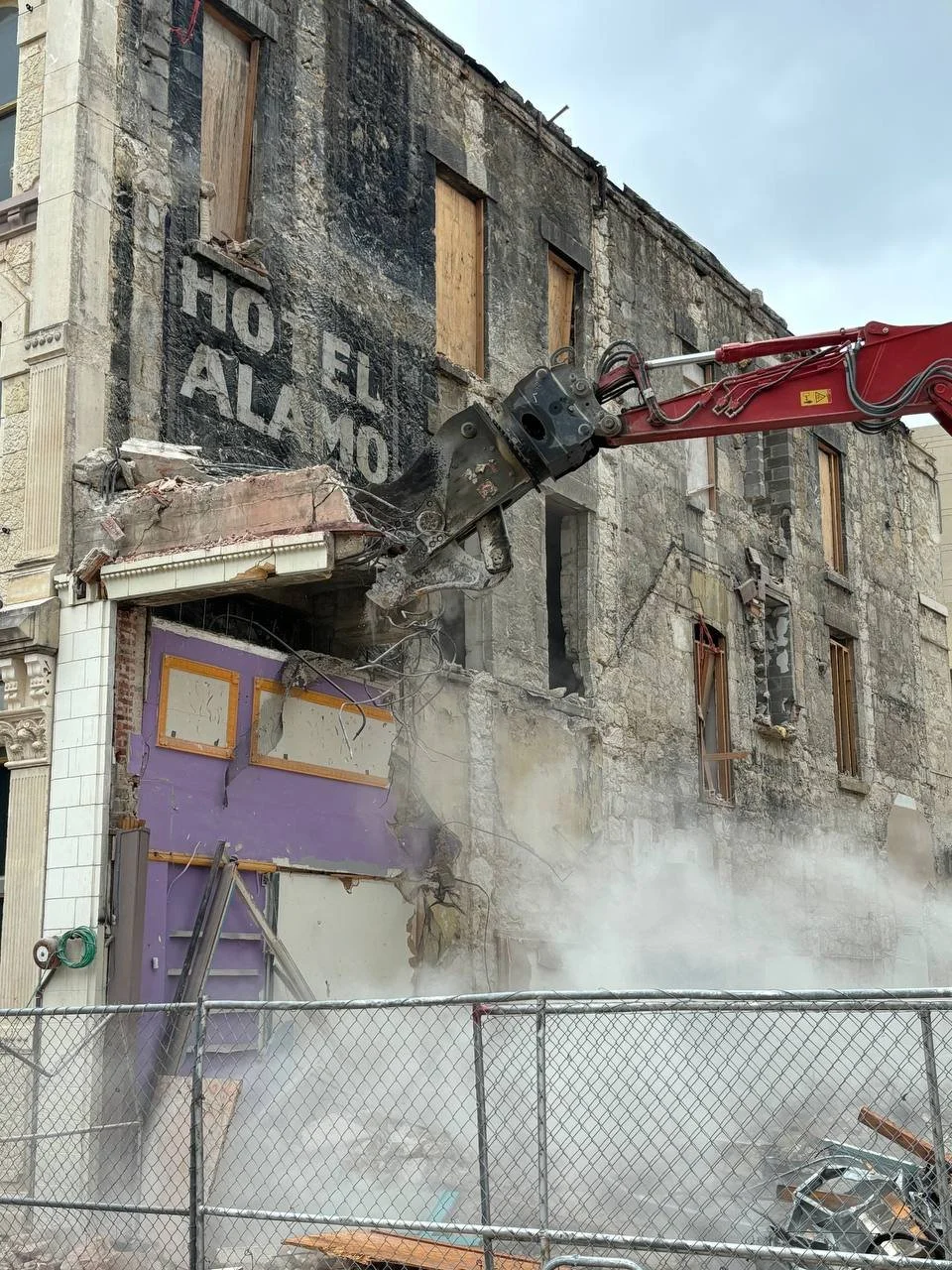
The Alamo, San Antonio Texas: demolition of the Palace Building in the heart of downtown San Antonio while preserving the adjacent Crockett and Woolworth Buildings, both of which carry significant historical designation.